
Does stewardship make you happy? Is it important to you as a business leader to be a good steward – of people, ideas, resources, and communities? Is it important to your business to foster, recognize and reward stewardship throughout career life-cycles?
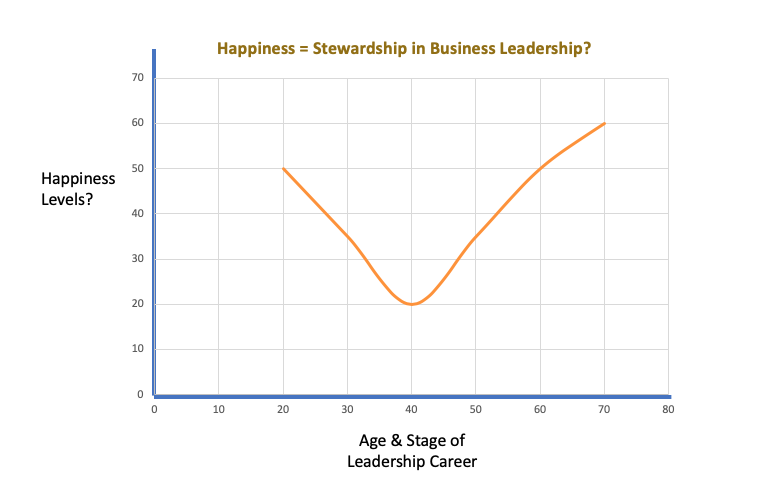
 The underlying premise of the “happiness curve”[1] is that we are “happiest” in our 20’s and then later in our 50’s, 60’s and beyond but often in a slump in our 30’s and 40’s when life’s demands make us more transactional, stressed and often depressed.[2] Is there a stewardship curve that is the double rainbow to the happiness curve – especially for business leaders? I think so.
As business leaders, stewards stand out. They are outward looking. They consider the well- being of others in their decision making – the environment, employment, communities, safety, health, and future consequences. They think long term. They are comfortable working in the “grey scale”. And maybe most importantly, their happiness is contagious for those that they lead – including their families.
In contrast, transactionalist business leaders are inward looking. They believe that what is good for “me” is in everyone’s best interest. As short term thinkers, they live in the “now”. They don’t care much about future impacts. They see those as abstractions. Beholden to financial engineers, everything is black and white – reflected on the balance sheet and profit and loss statements. The concept of solid stewardship and caring for others may be respected, but it is someone else’s job. It seems that they live “unhappy”.
I am thinking that it is easiest and most common for leaders to show stewardship at the beginning and end of careers, and less so in the middle when they are susceptible to becoming more transactional. The early stage entrepreneurs seem to be fairly happy. The later stage mentors seem happy. The middle age corporate climbers – maybe not so much.
The thing is, stewardship is a much needed attribute throughout one’s career – and should be fostered especially when leaders are in the middle of their careers. They will be happier, and the companies that they lead will perform better.
In mentorship, I often use the sports analogy – it is virtually impossible to hit a ball straight, when you “rip and grip it”. Think golf, tennis, baseball. When stressed, leaders use a much different part of the brain than when being honest stewards and thinking creatively – being happy.
Stewards form the glue for the fabric that supports our institutions and companies. They nurture intrinsic motivations which are the primary drivers of the modern workforce.[3] As Stephen Covey says, they have to deliver to earn trust.[4] Everyone gets that. But stewards also must have a bigger global view. They have to recognize that people work not just for a living wage – but because they believe in the business in which they invest their time.[5]
Why not be happy stewards for our entire careers? Where are you on the happiness – stewardship curve? Are you a happy steward? Why wait?

[1] Attributed to Jonathon Rauch, See footnote 2 below.
[2] Jonathon Rauch[2] provides a complete study and underlying science, that underlies the concept in his thoughtful work The Happiness Curve, Why Life Gets Better After 50. (St. Martin’s Press).
[3] Drive, The Surprising Truth About What Motivates Us. Daniel Pink
[4] Stephen Covey, The Speed of Trust.
[5] Pink id.,